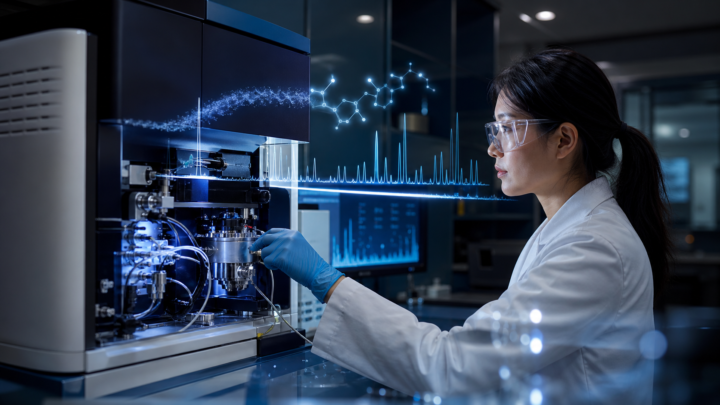


Peptide discovery is entering a new phase. Computational systems are no longer limited to ranking sequences that already exist. Modern generative models can propose new sequences, predict likely structures and interactions, and help researchers prioritize a much smaller set of candidates for synthesis and testing.
The shift matters because peptide sequence space is enormous. Even a short chain can have more possible combinations than any laboratory could make and screen directly. AI does not eliminate experimentation, but it can change where experimental effort is spent: away from broad, low-information screening and toward focused validation of candidates selected for multiple properties at once.
From structure prediction to molecular design
The 2024 Nobel Prize in Chemistry recognized computational protein design and protein structure prediction, marking a turning point for the field. Structure-prediction systems demonstrated that sequence-to-structure relationships could be learned at remarkable scale. The next generation extended this capability beyond isolated proteins to complexes containing proteins, nucleic acids, ions, small molecules and modified residues.
For peptide researchers, this broader interaction context is important. A useful sequence is not defined by folding alone. Researchers may need to understand whether it can adopt the intended conformation, approach a target surface, tolerate chemical modification, remain soluble and avoid undesirable interactions. Each question requires a different model or experimental assay.
Generative systems explore beyond known libraries
Traditional virtual screening starts with a finite list of candidates. Generative systems work differently: they learn patterns from sequence and structure data, then propose candidates that may not occur in the original database. Diffusion models, protein language models and Bayesian optimization can all be used to navigate this design space.
Recent studies illustrate the change. One deep-learning approach generated more than 10,000 structurally diverse cyclic peptide designs and experimentally confirmed atomic-level agreement for tested structures. Other work has used generative models to optimize peptide sequences under practical constraints, followed by chemical synthesis and laboratory characterization. The important advance is not simply that a model can produce a sequence; it is that the computational proposal is connected to a measurable experimental loop.
The wet laboratory remains the decision point
Predictions are hypotheses, not certificates. A high model score cannot establish chemical identity, purity, concentration, solubility, aggregation behavior or biological function. Those properties depend on synthesis, purification, formulation and the specific conditions of the assay.
A responsible AI-assisted workflow therefore contains several checkpoints:
- In-silico triage: filter sequences for structure, target compatibility and basic physicochemical constraints.
- Synthetic feasibility: assess difficult couplings, non-standard residues, cyclization strategy and expected purification burden.
- Analytical verification: confirm identity and impurity profile using orthogonal methods such as chromatography and mass spectrometry.
- Functional testing: evaluate activity using controls, replicates and pre-defined acceptance criteria.
- Iteration: return experimental results to the model so the next design round is informed by real data.
What counts as a breakthrough?
The most meaningful metric is not how many sequences a model can generate. It is how efficiently the complete pipeline converts computational proposals into reproducible experimental findings. Useful benchmarks include prospective hit rate, structural agreement, assay reproducibility, chemical diversity and the number of design cycles required to reach a defined objective.
AI is therefore best understood as a decision-support layer across the discovery process. It can make sequence exploration more systematic and expose relationships that are difficult to recognize manually. But strong experimental design, transparent reporting and batch-level analytical evidence remain essential.
Research outlook
The next step is likely to be tighter integration between generative design, automated synthesis and high-throughput analytics. Closed-loop platforms could propose a sequence, manufacture a small batch, collect analytical and functional data, and update the model with minimal delay. The scientific opportunity is substantial, but so is the need for careful validation, traceable data and clear separation between prediction and observation.
Selected references
- The Nobel Prize in Chemistry 2024: computational protein design and structure prediction
- Accurate structure prediction of biomolecular interactions with AlphaFold 3
- Cyclic peptide structure prediction and design using AlphaFold2
- A generative AI approach for peptide antibiotic optimization
This article is for scientific and educational discussion only. It does not provide medical advice or instructions for human use.