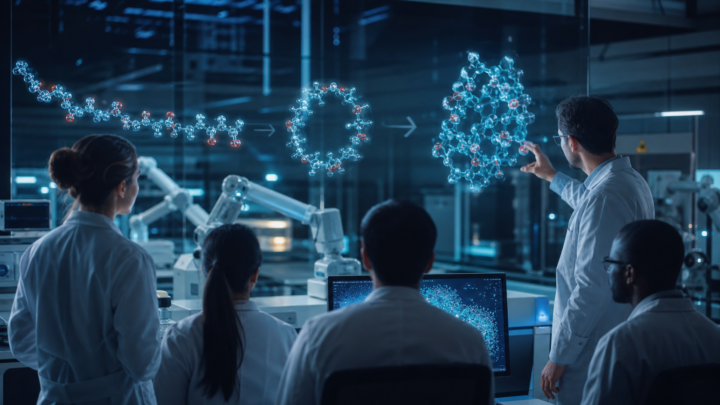

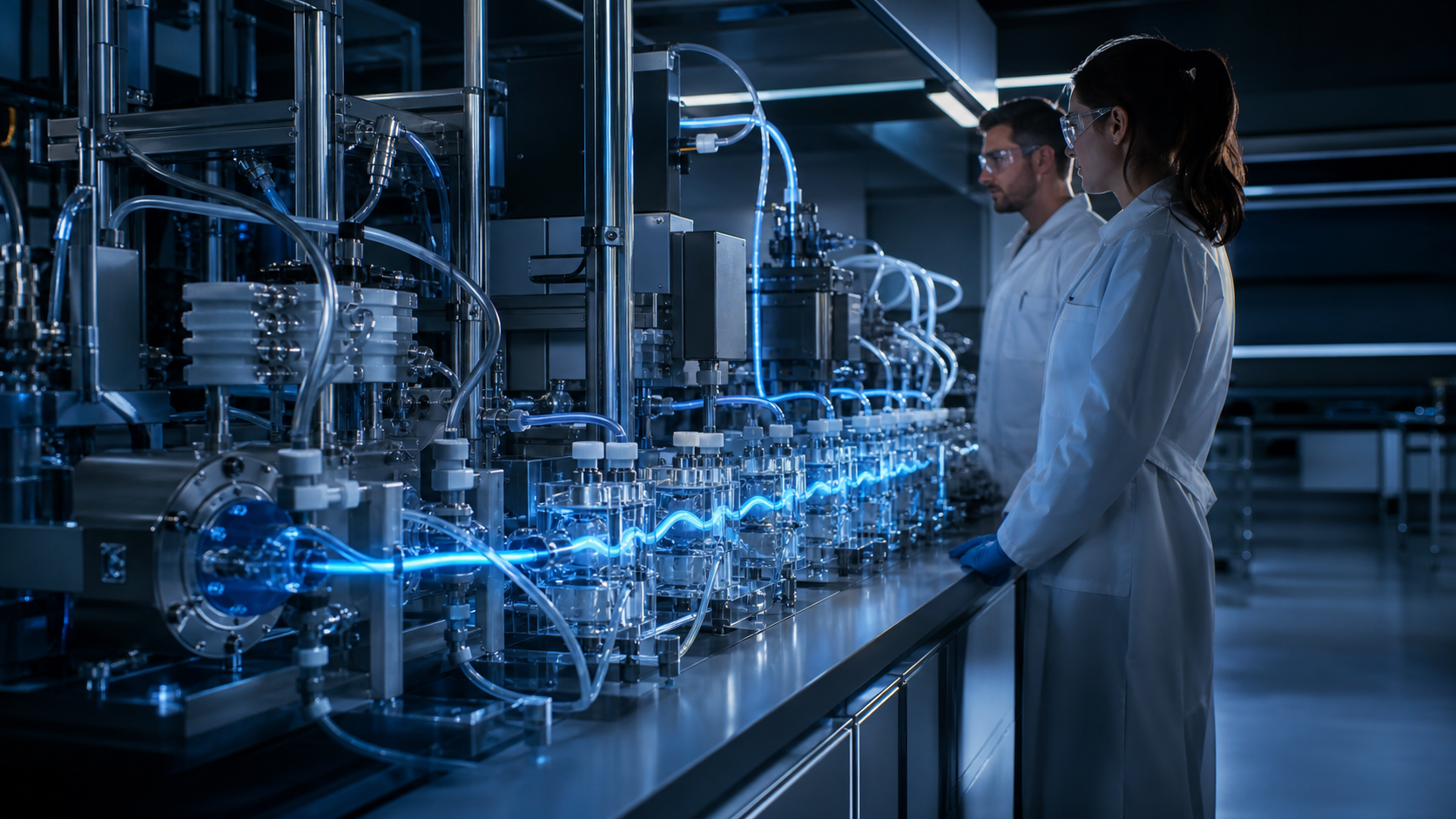
Solid-phase peptide synthesis transformed peptide chemistry by allowing cycles of deprotection, washing and coupling to be repeated on a resin-bound chain. Continuous-flow systems build on the same logic while moving reagents through controlled channels and heated reaction zones. The result can be faster mass transfer, precise residence times and richer process data.
Automated fast-flow research has demonstrated direct assembly of long peptide chains through hundreds of consecutive reactions. More recent reviews describe rapid synthesis beyond 200 residues, one-flow multi-component coupling and manufacturing approaches that extend from discovery scale toward kilogram-scale production.
What flow changes
In a conventional batch cycle, reagents are added to a vessel, allowed to react and then removed. In flow, reaction conditions can be controlled continuously. Temperature, flow rate, reagent concentration and residence time become programmable variables. This can shorten cycle times and make the process easier to monitor.
Flow is not automatically better for every sequence. Difficult couplings, aggregation on resin, incomplete deprotection and side reactions remain possible. The benefit is that deviations can be observed and investigated with greater temporal resolution.
Process analytical data becomes a design input
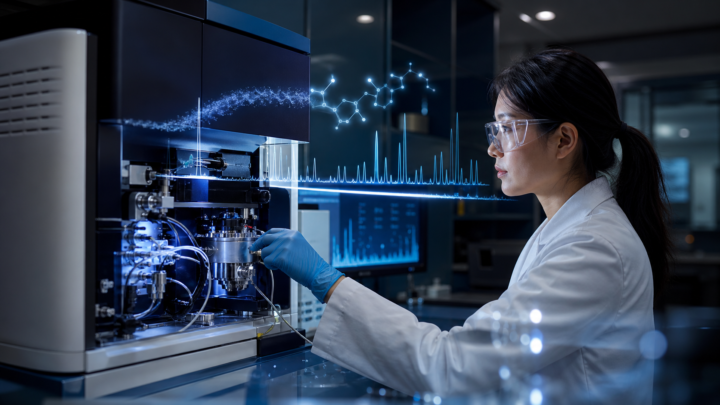
Ultraviolet monitoring of deprotection chemistry can produce a signal for every synthesis cycle. A published machine-learning study analyzed tens of thousands of individual reactions collected from an automated fast-flow instrument. The model learned sequence-dependent patterns and helped identify conditions associated with difficult steps.
This is an early example of a broader trend: synthesis equipment is becoming a data platform. When each cycle generates structured process data, researchers can compare runs, identify recurring failure modes and improve future protocols using evidence rather than intuition alone.
The real bottleneck moves downstream
Faster chain assembly does not guarantee a finished high-quality material. Cleavage, deprotection, cyclization, folding, purification, desalting and drying may still dominate total project time. A rapid synthesizer can also produce crude material faster than the analytical and purification workflow can evaluate it.
A balanced platform therefore considers the full process:
- Sequence assessment: identify aggregation-prone regions and chemically sensitive residues before synthesis.
- Reaction control: define temperature, stoichiometry and residence time for each class of coupling.
- In-process monitoring: record deprotection and pressure signals to detect deviations.
- Purification strategy: design chromatography around expected deletion, truncation and modification products.
- Analytical release: use complementary methods for identity, purity and content rather than relying on a single chromatogram.
Sustainability and scale
Peptide synthesis can consume substantial quantities of solvent and coupling reagents. Flow equipment may reduce time and improve reaction efficiency, but sustainability depends on the complete mass balance. Solvent selection, reagent excess, resin loading, purification yield and waste treatment should all be measured.
Scale-up also requires more than increasing flow rate. Heat transfer, pressure, mixing, resin swelling and equipment cleaning can behave differently at larger scale. A robust development program defines critical process parameters and shows how they relate to impurity formation and final quality attributes.
Research outlook
The most promising direction is an integrated, closed-loop workflow. Online signals could identify an incomplete reaction, adjust the next cycle and flag material for targeted analysis. Combined with improved purification and high-resolution mass spectrometry, this could shorten development timelines while increasing traceability.
Continuous-flow synthesis should therefore be viewed as one component of a connected manufacturing system. Its value is greatest when speed, data quality, purification and analytical control advance together.
Selected references
- Synthesis of proteins by automated flow chemistry
- Deep learning for prediction and optimization of fast-flow peptide synthesis
- Accelerating innovation in peptide synthesis through continuous flow
For research and process-development discussion only.